
133. Clone Graph 克隆图
作者: 负雪明烛 id: fuxuemingzhu 个人博客: https://fuxuemingzhu.cn/
题目地址:https://leetcode.com/problems/clone-graph/
Given a reference of a node in a connected undirected graph, return a deep copy (clone) of the graph. Each node in the graph contains a val (int) and a list (List[Node]) of its neighbors.
Example:
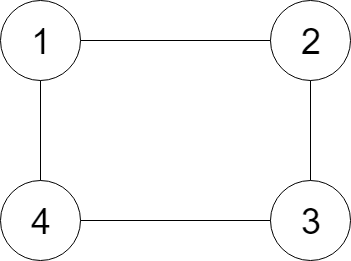
Input:
{"$id":"1","neighbors":[{"$id":"2","neighbors":[{"$ref":"1"},{"$id":"3","neighbors":[{"$ref":"2"},{"$id":"4","neighbors":[{"$ref":"3"},{"$ref":"1"}],"val":4}],"val":3}],"val":2},{"$ref":"4"}],"val":1}
Explanation:Node 1's value is 1, and it has two neighbors: Node 2 and 4.Node 2's value is 2, and it has two neighbors: Node 1 and 3.Node 3's value is 3, and it has two neighbors: Node 2 and 4.Node 4's value is 4, and it has two neighbors: Node 1 and 3.
Note:
- The number of nodes will be between 1 and 100.
- The undirected graph is a simple graph, which means no repeated edges and no self-loops in the graph.
- Since the graph is undirected, if node p has node q as neighbor, then node q must have node p as neighbor too.
- You must return the copy of the given node as a reference to the cloned graph.
完全复制一个图结构。返回新的起始节点。
这个题和138. Copy List with Random Pointer比较类似。至于图结构,我们可以使用DFS和BFS两种结构进行遍历。
一般的遍历只需要保存是否遍历过这个节点即可,但是由于这个题需要把neighboors对应复制过来。那么需要进行改进,改进的方式是把set改成dict,保存每个老节点对应的新节点是多少。在Python中,字典直接保存对象(指针)之间的映射。所以,我们直接把遍历过的对象和复制出来的对象一一对应即可。当我们遍历到一个新的节点的时候,需要判断这个节点是否在字典中出现过,如果出现过就把它对应的复制出来的对象放到其neighboors里,若没有出现过,那么就重新构造该节点,并把原节点和该节点放到字典中保存。
Python代码如下:
"""# Definition for a Node.class Node(object):    def __init__(self, val, neighbors):        self.val = val        self.neighbors = neighbors"""class Solution(object):    def cloneGraph(self, node):        """        :type node: Node        :rtype: Node        """        node_copy = self.dfs(node, dict())        return node_copy
    def dfs(self, node, hashd):        if not node: return None        if node in hashd: return hashd[node]        node_copy = Node(node.val, [])        hashd[node] = node_copy        for n in node.neighbors:            n_copy = self.dfs(n, hashd)            if n_copy:                node_copy.neighbors.append(n_copy)        return node_copy
C++代码如下:
/*// Definition for a Node.class Node {public:    int val;    vector<Node*> neighbors;
    Node() {}
Node(int _val, vector<Node*> _neighbors) { val = _val; neighbors = _neighbors; }};*/class Solution {public: Node* cloneGraph(Node* node) { if (!node) return nullptr; if (m_.count(node)) return m_[node]; Node* node_copy = new Node(node->val, {}); m_[node] = node_copy; for (Node* n : node->neighbors) { node_copy->neighbors.push_back(cloneGraph(n)); } return node_copy; }private: unordered_map<Node*, Node*> m_;};这个题同样也可以使用BFS解决。方法也是使用了字典保存每一个对应关系。当新构造出一个节点之后,必须同时把它放到字典中保存,这个很重要。另外就是每遍历到一个节点时,都要把它的所有邻居放到队列中。
python代码如下:
"""# Definition for a Node.class Node(object): def __init__(self, val, neighbors): self.val = val self.neighbors = neighbors"""class Solution(object): def cloneGraph(self, node): """ :type node: Node :rtype: Node """ que = collections.deque() hashd = dict() que.append(node) node_copy = Node(node.val, []) hashd[node] = node_copy while que: t = que.popleft() if not t: continue for n in t.neighbors: if n not in hashd: hashd[n] = Node(n.val, []) que.append(n) hashd[t].neighbors.append(hashd[n]) return node_copyC++代码如下:
/*// Definition for a Node.class Node {public:    int val;    vector<Node*> neighbors;
    Node() {}
Node(int _val, vector<Node*> _neighbors) { val = _val; neighbors = _neighbors; }};*/class Solution {public: Node* cloneGraph(Node* node) { queue<Node*> q; q.push(node); unordered_map<Node*, Node*> m_; Node* node_copy = new Node(node->val, {}); m_[node] = node_copy; while (!q.empty()) { Node* t = q.front(); q.pop(); if (!t) continue; for (Node* n : t->neighbors) { if (!m_.count(n)) { m_[n] = new Node(n->val, {}); q.push(n); } m_[t]->neighbors.push_back(m_[n]); } } return node_copy; }};2019 年 3 月 9 日 —— 妇女节快乐
评论与交流