
173. Binary Search Tree Iterator 二叉搜索树迭代器
作者: 负雪明烛 id: fuxuemingzhu 个人博客: https://fuxuemingzhu.cn/
题目地址:https://leetcode.com/problems/binary-search-tree-iterator/description/
Implement an iterator over a binary search tree (BST). Your iterator will be initialized with the root node of a BST.
Calling next() will return the next smallest number in the BST.
Example:
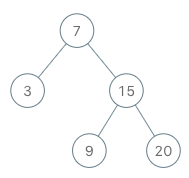
BSTIterator iterator = new BSTIterator(root);iterator.next(); // return 3iterator.next(); // return 7iterator.hasNext(); // return trueiterator.next(); // return 9iterator.hasNext(); // return trueiterator.next(); // return 15iterator.hasNext(); // return trueiterator.next(); // return 20iterator.hasNext(); // return falseNote: next() and hasNext() should run in average O(1) time and uses O(h) memory, where h is the height of the tree.
Credits: Special thanks to @ts for adding this problem and creating all test cases.
实现BST的从大到小依次输出值的操作。实现两个函数,hasNext()和next(),操作的时间复杂度是O(1),空间复杂度是O(h)。
保存全部节点
Section titled “保存全部节点”一般地,对时间要求比较严格的,我们可以使用空间进行补偿。所以使用一个栈,在初始化的过程中,就使用中序遍历,把BST的中序遍历是有序的这个特点用上。再定义hasnext()和next()就很容易了。
对中序遍历进行了小改进,导致是降序排列的。
但是我们要注意的是,下面的做法的空间复杂度是O(N)的,所以严格来说是不符合题目要求的。
python代码如下:
# Definition for a  binary tree node# class TreeNode(object):#     def __init__(self, x):#         self.val = x#         self.left = None#         self.right = None
class BSTIterator(object):    def __init__(self, root):        """        :type root: TreeNode        """        self.stack = []        self.inOrder(root)
    def inOrder(self, root):        if not root:            return        self.inOrder(root.right)        self.stack.append(root.val)        self.inOrder(root.left)
    def hasNext(self):        """        :rtype: bool        """        return len(self.stack) > 0
    def next(self):        """        :rtype: int        """        return self.stack.pop()
# Your BSTIterator will be called like this:# i, v = BSTIterator(root), []# while i.hasNext(): v.append(i.next())
只保留左节点
Section titled “只保留左节点”下面的做法的空间复杂度是O(h),做法是每次保存要遍历的节点的所有左孩子。这样,每次最多也就是H个节点被保存,当遍历了这个节点之后,需要把该节点的右孩子的所有左孩子放到栈里,这就是个中序遍历的过程。
# Definition for a binary tree node.# class TreeNode(object):#     def __init__(self, x):#         self.val = x#         self.left = None#         self.right = None
class BSTIterator(object):
    def __init__(self, root):        """        :type root: TreeNode        """        self.stack = []        self.push_left(root)
    def next(self):        """        @return the next smallest number        :rtype: int        """        node = self.stack.pop()        self.push_left(node.right)        return node.val
    def hasNext(self):        """        @return whether we have a next smallest number        :rtype: bool        """        return self.stack
    def push_left(self, root):        while root:            self.stack.append(root)            root = root.left
# Your BSTIterator object will be instantiated and called as such:# obj = BSTIterator(root)# param_1 = obj.next()# param_2 = obj.hasNext()2018 年 3 月 4 日 2019 年 3 月 23 日 —— 周末也要加油呀
评论与交流