
230. Kth Smallest Element in a BST 二叉搜索树中第K小的元素
- 作者: 负雪明烛
- id: fuxuemingzhu
- 个人博客: https://fuxuemingzhu.cn/
- 公众号:负雪明烛
- 本文关键词:算法题,刷题,Leetcode, 力扣,二叉搜索树,BST,第 k 小的元素,Python, C++, Java
题目地址:https://leetcode.com/problems/kth-smallest-element-in-a-bst/#/description
Given a binary search tree, write a function kthSmallest to find the kth smallest element in it.
Note:
- You may assume k is always valid, 1 ≤ k ≤ BST’s total elements.
Example 1:
Input: root = [3,1,4,null,2], k = 1 3 / \ 1 4 \ 2Output: 1Example 2:
Input: root = [5,3,6,2,4,null,null,1], k = 3 5 / \ 3 6 / \ 2 4 / 1Output: 3Follow up:
- What if the BST is modified (insert/delete operations) often and you need to find the kth smallest frequently? How would you optimize the kthSmallest routine?
找出一个BST中第K小的数字是多少。
各位题友大家好! 我是负雪明烛。
今天题目重点只有一个:二叉搜索树(BST)。
遇到二叉搜索树,立刻想到这句话:
「二叉搜索树(BST)的中序遍历是有序的」。
这是解决所有二叉搜索树问题的关键。
题目要求 BST 中第 k 小的元素,等价于求 BST 中序遍历的第 k 个元素。
分享二叉树遍历的模板:先序、中序、后序遍历方式的区别在于把「执行操作」放在两个递归函数的位置。
伪代码在下面。
- 先序遍历:
def dfs(root): if not root: return 执行操作 dfs(root.left) dfs(root.right)- 中序遍历:
def dfs(root): if not root: return dfs(root.left) 执行操作 dfs(root.right)- 后序遍历:
def dfs(root): if not root: return dfs(root.left) dfs(root.right) 执行操作本题是使用了中序遍历,所以把「执行操作」这一步改成自己想要的代码。
于是有了下面两种写法。
方法一:数组保存中序遍历结果
Section titled “方法一:数组保存中序遍历结果”这个方法是最直观的,也最不容易出错的。
- 先中序遍历,把结果放在数组中;
- 最后返回数组的第 k 个元素。
对应的代码如下,二叉树的各种遍历方式是基本功,务必要掌握。
Java 代码如下:
public class Solution { List<Integer> list; public int kthSmallest(TreeNode root, int k) { list = new ArrayList<Integer>(); dfs(root); return list.get(k - 1); } public void dfs(TreeNode root){ if(root == null){ return; } dfs(root.left); list.add(root.val); dfs(root.right); }}C++ 代码如下:
class Solution {public: int kthSmallest(TreeNode* root, int k) { vector<int> res; dfs(root, res); return res[k - 1]; } void dfs(TreeNode* root, vector<int>& res) { if (!root) return; dfs(root->left, res); res.push_back(root->val); dfs(root->right, res); }};Python 语言如下:
class Solution(object):    def kthSmallest(self, root, k):        res = []        self.dfs(root, res)        return res[k - 1]
    def dfs(self, root, res):        if not root: return        self.dfs(root.left, res)        res.append(root.val)        self.dfs(root.right, res)
复杂度分析:
- 时间复杂度:$O(N)$,因为每个节点只访问了一次;
- 空间复杂度:$O(N)$,因为需要数组保存二叉树的每个节点值。
方法二:只保存第 k 个节点
Section titled “方法二:只保存第 k 个节点”在方法一中,我们保存了整个中序遍历数组,比较浪费空间。
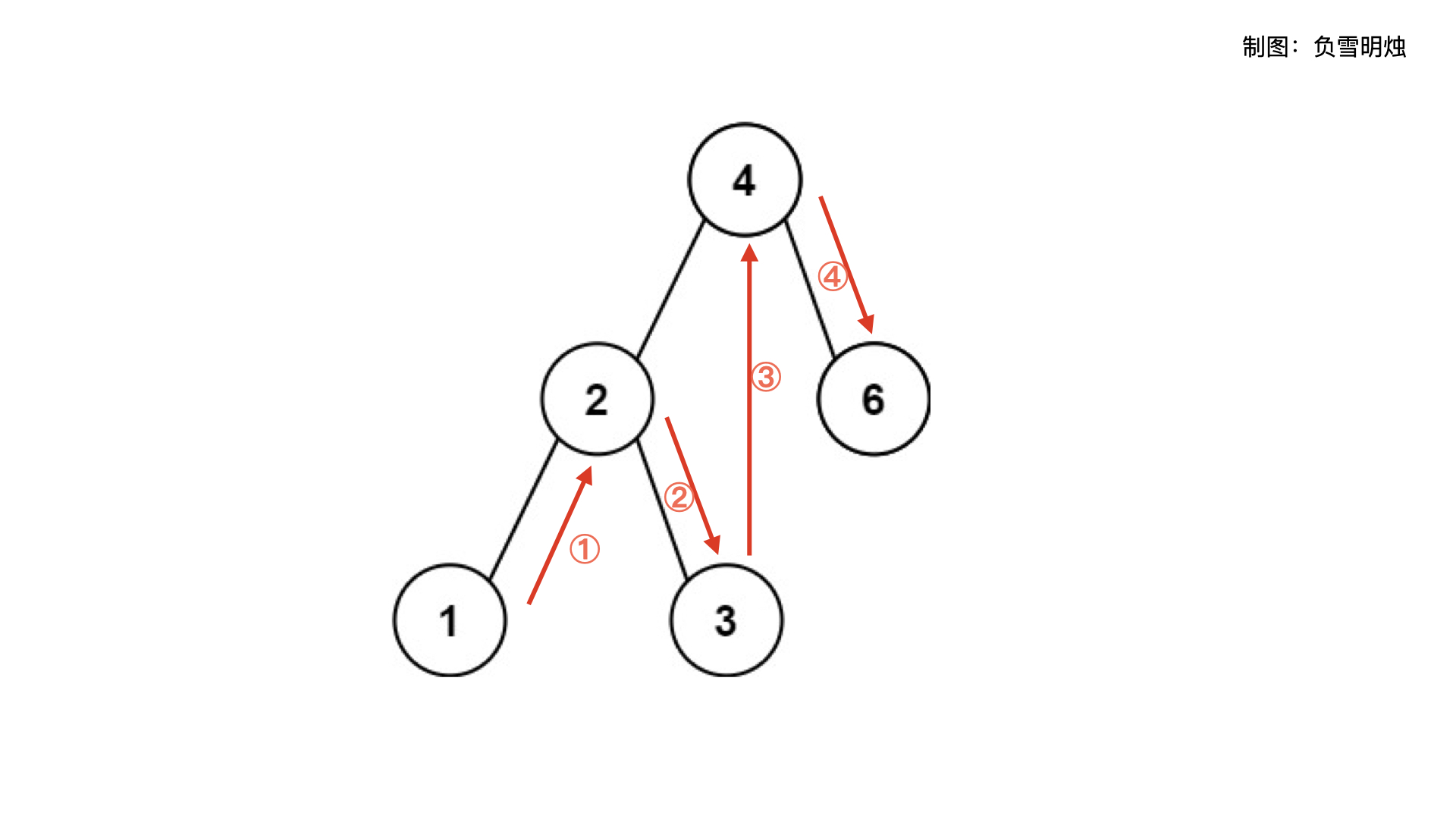
其实我们只需要知道,在中序遍历的时候,第 k 个被访问的节点即可。访问到第 k 个节点后,递归终止,后面的节点就不用访问了。
下图展示了中序遍历过程中的节点访问顺序。
具体的做法中,我们需要需要两个变量:
- 用一个全局变量保存最终的结果;
- 用一个全局变量保存当前访问到第几个节点。
如果不使用全局变量,而是使用函数传参,需要注意「值传递」和「引用传递」的区别:
值传递:每个递归的内部都需要对同一个变量修改,如果用普通函数的传参,对于 int 型的参数,使用的是值传递,即拷贝了一份传到了函数里面。那么函数里面对 int 型的修改不会影响外边的变量。
使用全局变量,可以保证递归函数的每次修改都是反映到全局的,从而保证遍历到第 k 个的时候,所有的递归立刻停止。
Java 代码如下:
public class Solution {    int res;    int count;
    public int kthSmallest(TreeNode root, int k) {        res = 0;        count = k;        dfs(root);        return res;    }    public void dfs(TreeNode root){        if(root == null){            return;        }        dfs(root.left);        count--;        if(count == 0){            res = root.val;            return;        }        dfs(root.right);    }}
C++ 代码如下:
class Solution {public: int kthSmallest(TreeNode* root, int k) { count = k; dfs(root); return res; } void dfs(TreeNode* root) { if (!root) return; dfs(root->left); count -= 1; if (count == 0) { res = root->val; return; } dfs(root->right); }private: int res; int count;};Python 代码如下:
class Solution(object):    def kthSmallest(self, root, k):        self.res = 0        self.count = k        self.dfs(root)        return self.res
    def dfs(self, root):        if not root: return        self.dfs(root.left)        self.count -= 1        if self.count == 0:            self.res = root.val            return        self.dfs(root.right)
复杂度分析:
- 时间复杂度:$O(k)$,因为只访问了前 $k$ 个节点;
- 空间复杂度:$O(h)$,其中 $h$ 为树的高度,因为递归用了系统栈,而栈的深度最多只有树的高度。
待补。
- 二叉树的多种遍历方式必须要掌握。
- 一定切记:二叉搜索树的中序遍历是有序的。
- 另外建议刚开始刷题的朋友,不妨从二叉树上手。
类似题目:
我是 @负雪明烛 ,刷算法题 1000 多道,写了 1000 多篇算法题解,收获阅读量 300 万。
关注我,你将不会错过我的精彩动画题解、面试题分享、组队刷题活动,进入主页 @负雪明烛 右侧有刷题组织,从此刷题不再孤单。
- 在刷题的时候,如果你不知道该怎么刷题,可以看 LeetCode 应该怎么刷?
- 如果你觉得题目太多,想在短时间内快速提高,可以看 LeetCode 最经典的 100 道题。
2017 年 4 月 10 日 2019 年 1 月 25 日 —— 这学期最后一个工作日 2021 年 10 月 17 日
评论与交流