
300. Longest Increasing Subsequence 最长递增子序列
作者: 负雪明烛 id: fuxuemingzhu 个人博客: https://fuxuemingzhu.cn/
题目地址:https://leetcode.com/problems/longest-increasing-subsequence/description/
Given an unsorted array of integers, find the length of longest increasing subsequence.
Example:
Input: [10,9,2,5,3,7,101,18]Output: 4Explanation: The longest increasing subsequence is [2,3,7,101], therefore the length is 4.Note:
- There may be more than one LIS combination, it is only necessary for you to return the length.
- Your algorithm should run in O(n2) complexity.
Follow up: Could you improve it to O(n log n) time complexity?
求数组的最长递增子序列。即LIS.
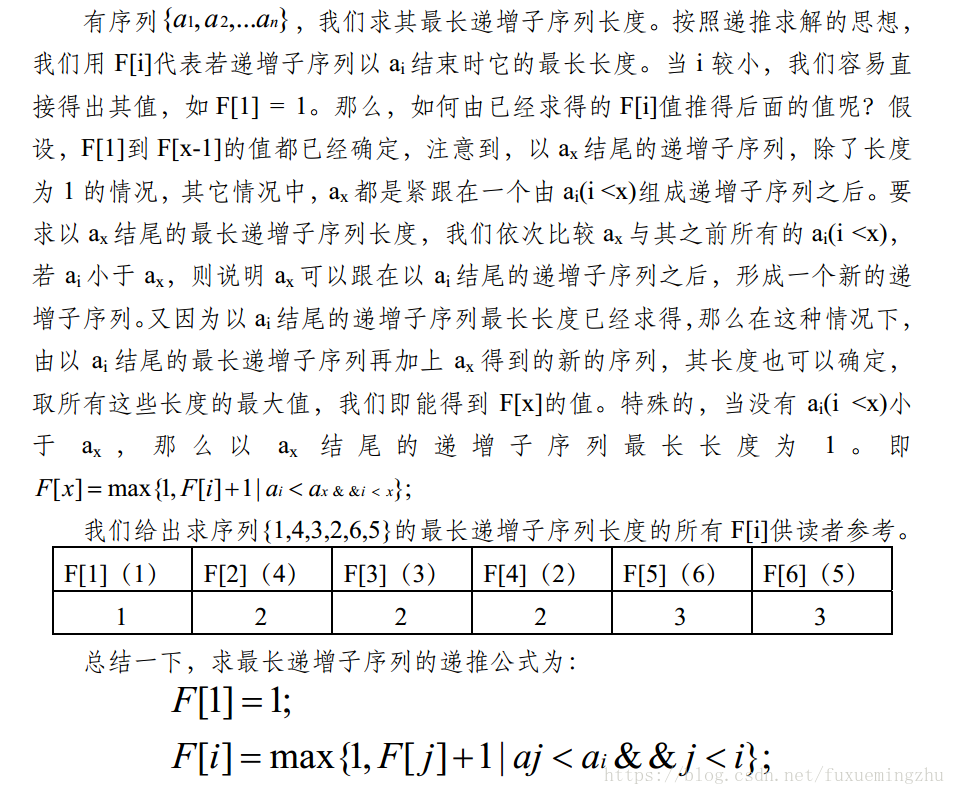
这个题是动态规划的经典题目,其实没有那么难,只要明白其中的道理即可。在《计算机考研机试指南》P160中有详细的解答。
核心思想是使用一个数组dp来保存,dp[i]的意义是到该位置为止的最长递增子序列。
最后求所有位置的最大值,而不是dp的最后元素。
Python代码:
class Solution(object): def lengthOfLIS(self, nums): """ :type nums: List[int] :rtype: int """ if not nums: return 0 dp = [0] * len(nums) dp[0] = 1 for i in range(1, len(nums)): tmax = 1 for j in range(0, i): if nums[i] > nums[j]: tmax = max(tmax, dp[j] + 1) dp[i] = tmax return max(dp)C++代码如下:
class Solution {public: int lengthOfLIS(vector<int>& nums) { const int N = nums.size(); if (N == 0) return 0; // dp[i] means the LIS when the subsequence ends with nums[i] vector<int> dp(N, 1); for (int i = 1; i < N; ++i) { for (int j = i - 1; j >= 0; --j) { if (nums[j] < nums[i]) { dp[i] = max(dp[i], dp[j] + 1); } } } return *max_element(dp.begin(), dp.end()); }};2018 年 4 月 4 日 —— 清明时节雪纷纷~~下雪了,惊不惊喜,意不意外? 2019 年 1 月 7 日 —— 新的一周开始啦啦啊
评论与交流